


Most eCommerce stores run retention programs without knowing which ones work.
They send loyalty emails, launch re-engagement campaigns, and tweak the post-purchase experience — then cross their fingers. The problem isn’t the tactics. It’s that without data, you can’t tell whether a 5% lift came from your loyalty program, your email sequence, or just a seasonal bump.
The solution is to start with your baseline numbers, measure every strategy you run, and scale what actually moves the needle.
Keeping an existing customer costs a fraction of what it takes to win a new one — and with acquisition costs rising every year, the gap is only getting wider.
In This Article:
- Why eCommerce Customer Retention Is Worth Obsessing Over
- Know Your eCommerce Retention Numbers Before You Pick a Strategy
- 6 eCommerce Customer Retention Strategies
- 1. Build a Loyalty Program That Pays for Itself — and Track Whether It Does
- 2. Use Personalized Email Marketing to Bring Customers Back
- 3. Excel at Customer Service and Measure the Impact on Retention
- 4. Perfect Your Post-Purchase Experience
- 5. Use Data-Driven Personalization to Drive Repeat Purchases
- 6. Master Re-engagement Campaigns — and Know Which Ones Win
- Use MonsterInsights User Journeys to See What Repeat Customers Actually Do
- Set Up GA4 Audiences for Repeat Buyers vs. One-Time Buyers
- FAQs About eCommerce Customer Retention Strategies
Why eCommerce Customer Retention Is Worth Obsessing Over
Customer retention matters for eCommerce businesses because it cuts acquisition costs, increases lifetime value through repeat purchases, and builds the kind of brand loyalty that drives word-of-mouth growth. Retained customers cost far less to serve — and they spend more over time.
A few retention numbers worth knowing:
- Repeat customers spend 67% more than new customers
- The success rate of selling to an existing customer is 60–70%, compared to just 5–20% for a new prospect
- Loyal customers are 5x more likely to purchase again and 4x more likely to refer friends
- 65% of a company’s business typically comes from existing customers
The urgency has never been greater: according to McKinsey, customer acquisition costs have risen an average of 60% over the past five years. Keeping the customers you already have isn’t just smart — it’s increasingly the only reliable path to profitable growth.
Beyond revenue, retained customers become brand ambassadors. They’re more willing to try new products, more likely to leave positive reviews, and more forgiving when things go wrong. They also provide valuable feedback you can actually act on.
Know Your eCommerce Retention Numbers Before You Pick a Strategy
Too many stores launch a loyalty program or kick off a re-engagement campaign before checking their baseline numbers. When results are mixed, they can’t tell whether to double down or cut it — because they have nothing to compare against. The fix is simple: look at your data first.
Before you invest time in any retention strategy, you need to know three things about your store:
- Average order value (AOV) — what a typical transaction is worth, directly visible in the eCommerce Report
- Purchase frequency — how often customers come back to buy (derive this by looking at total orders divided by unique customers over a given period)
- Customer lifetime value — derived from AOV multiplied by purchase frequency over time; the number that tells you how much a retained customer is actually worth
These numbers tell you which retention levers have the highest payoff. If your AOV is low but purchase frequency is high, focus on upsells and loyalty rewards. If customers buy once and disappear, re-engagement and post-purchase nurture deserve your attention first.
MonsterInsights Pro — a WordPress analytics plugin — has an eCommerce Report that gives you this baseline right inside WordPress — no logging into GA4 required. You’ll see total revenue, conversion rate, average order value, and top products in one clean dashboard.
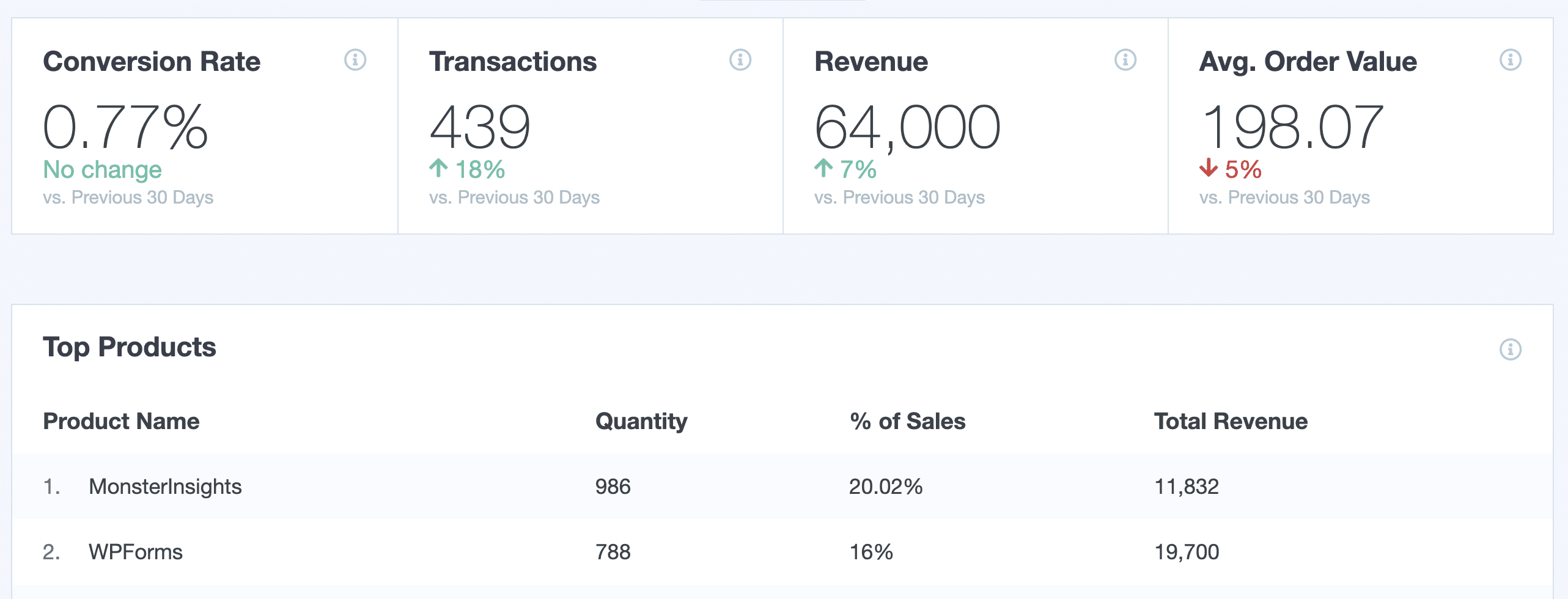
Once you’re looking at these numbers regularly, patterns start to emerge.
You’ll notice seasonal drops in repeat purchases, or you’ll see that a certain traffic source brings buyers who almost never return. That’s the kind of insight that makes your retention strategy intentional — not reactive.
I’d recommend pulling these numbers before committing resources to any of the six strategies below. Your data will tell you which one deserves your attention first.
6 eCommerce Customer Retention Strategies
1. Build a Loyalty Program That Pays for Itself — and Track Whether It Does
A well-designed loyalty program can make a measurable difference in your eCommerce retention numbers. Loyalty program members spend 27% more than non-members on average — but only if the program is easy to understand and genuinely rewarding.
The key elements of a loyalty program that keeps buyers coming back:
- Easy-to-understand point system with attainable rewards
- Multiple ways to earn points (purchases, reviews, referrals)
- Exclusive member benefits and tiered rewards for bigger spenders
- Mobile-friendly access and regular program updates
Promoting your program everywhere — during checkout, in email communications, and prominently on your site — makes a real difference in participation rate. The easier it is to join and earn, the more customers will actually use it.
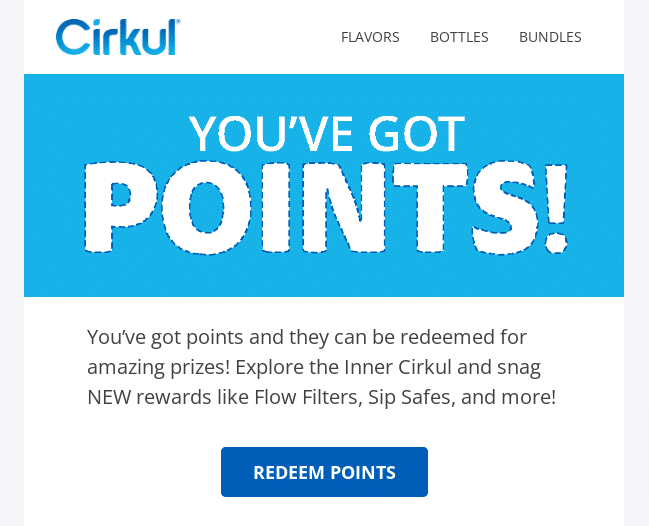
The example above works because the points structure is spelled out clearly — no confusion about how to earn or redeem. That transparency is what drives participation.
How to measure this:
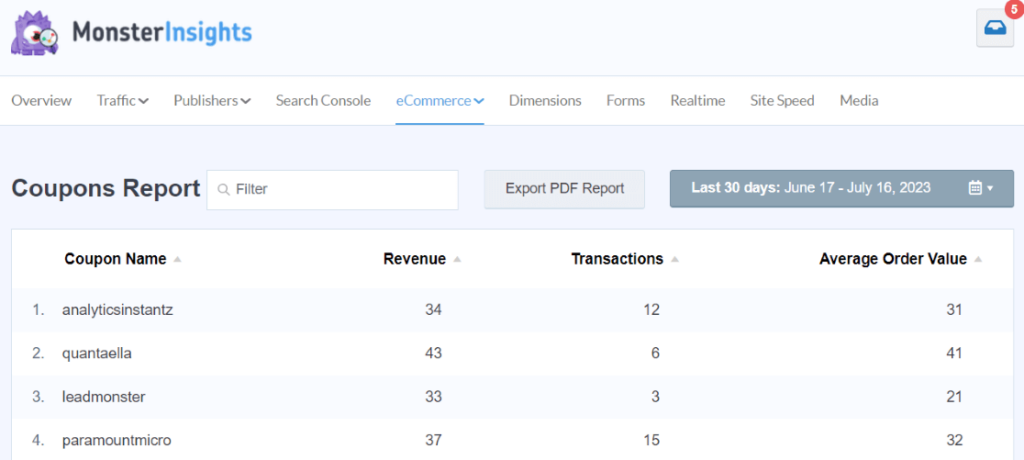
You can use the MonsterInsights Coupons Report (Pro) to track which coupon codes your loyalty members are actually redeeming, the average order value per coupon, and the revenue generated by each code.
If your top loyalty coupon has a low redemption rate, the reward may not be compelling enough — or members are not hearing about it often enough.
Tracking coupon performance at this level lets you distinguish between a loyalty program that’s genuinely driving repeat purchases and one that’s simply discounting revenue you would have earned anyway.
For a full walkthrough, see how to track coupon codes in Google Analytics with MonsterInsights.
2. Use Personalized Email Marketing to Bring Customers Back
Email marketing remains one of the highest-ROI channels for eCommerce retention. Conversions via email typically outperform organic search — often by 2x or more. Generic batch-and-blast emails don’t move the needle the way they used to. The stores winning at retention use data to personalize every touchpoint.
The most effective personalized email types to build into your retention workflow:
- Welcome emails using the recipient’s first name and purchase context
- Location-based offers and restocking updates
- Birthday messages with a meaningful discount
- Loyalty program status updates (“You’re 200 points away from a reward”)
- Abandoned cart reminders triggered by real on-site behavior
- Product recommendations based on browsing or purchase history
- Re-engagement sequences for customers who have gone quiet
To segment your audience effectively, track on-site behavior and use that data to trigger the right emails at the right time. Your email platform tells part of the story — but your website analytics fills in what happens after the click.
For more on what makes email campaigns actually convert, the eCommerce email marketing best practices guide is worth a read alongside this one.
How to measure this:
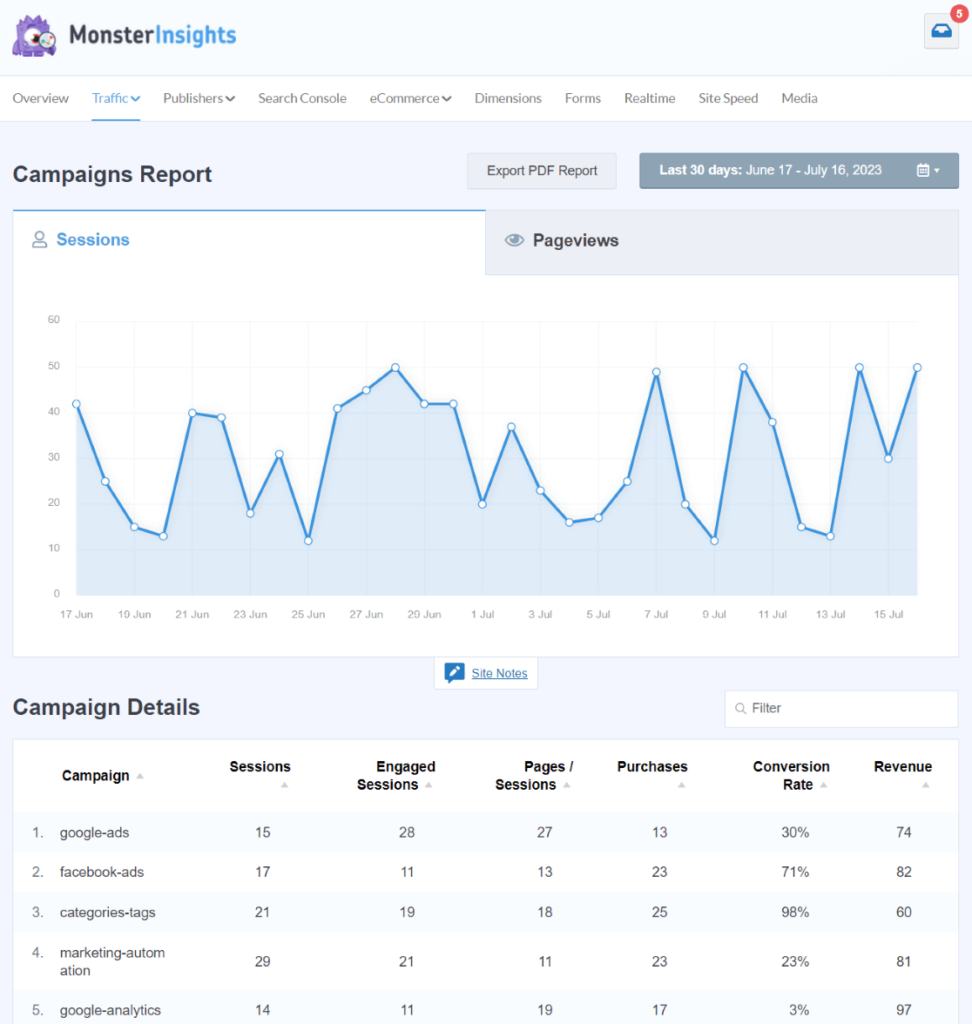
Use the MonsterInsights Campaigns Report (Plus+) to see how each UTM-tagged email campaign performs — sessions, revenue, and conversions per campaign. Build your UTM links with the Smart URL Builder (also Plus+) so every email link is tracked consistently. This tells you which specific emails are actually driving repeat purchases — not just opens.
With this view, you can see at a glance which email campaigns are generating real return visits — making it straightforward to cut what isn’t working and invest more in the sequences that are.
To see which email campaigns drive the most repeat purchases, read the guide on how to set up Google Analytics email tracking with MonsterInsights.
3. Excel at Customer Service and Measure the Impact on Retention
Outstanding customer service turns a one-time buyer into a lifelong customer. Poor service does the opposite — and leaves a review trail you can’t undo. The difference isn’t just responsiveness; it’s whether customers feel heard before, during, and after a problem.
The elements that consistently appear in high-retention customer service programs:
- Multiple support channels (email, live chat, phone)
- Quick response times with clear expectations
- A detailed FAQ page that answers common questions before a ticket is opened
- Chatbots for 24/7 basic support
- A clear, fair return policy that is easy to find
- Follow-up after resolved issues to confirm customer satisfaction
I’d also recommend asking for feedback on every support interaction — not just product reviews. Was the issue actually resolved?
Rating the support experience gives you a feedback loop that’s separate from product satisfaction, and it surfaces training opportunities before they become churn drivers.
4. Perfect Your Post-Purchase Experience
The sale isn’t the end of the customer relationship — it’s the beginning of it. What you do in the 7 days after a purchase has more influence on whether a customer comes back than almost anything else.
A strong post-purchase experience starts with the basics:
- Order confirmation email with tracking information
- Proactive shipping updates so the customer isn’t left wondering
- Clear return and exchange instructions — easy to find, not buried in fine print
- Product care guides, tutorials, or setup tips where relevant
- A personalized thank-you message that doesn’t feel automated
After the delivery window closes, ask for feedback. Keep the ask simple and specific. A short post-purchase survey with 2–3 targeted questions outperforms a long form almost every time. Make it frictionless — include a direct link, ask about the product and the experience separately, and tell customers how their feedback is being used.
When negative feedback comes in — and it will — responding quickly matters more than you’d think. A fast, empathetic response to a complaint converts more dissatisfied customers into loyal ones than any loyalty discount can.
The User Journeys section below walks through exactly how to read these paths for your best customers.
5. Use Data-Driven Personalization to Drive Repeat Purchases
Today’s shoppers expect experiences tailored to them. In fact, 78% of consumers have chosen, recommended, or paid more for a brand that delivers a personalized experience. Generic shopping journeys are leaving revenue on the table.
The highest-impact personalization tactics for eCommerce retention:
- Widgets showing recently viewed items
- “Customers also bought” sections powered by real purchase data
- Customized homepage content for returning vs. first-time visitors
- Location-based shipping or offer display
- Product recommendations based on purchase and browsing history
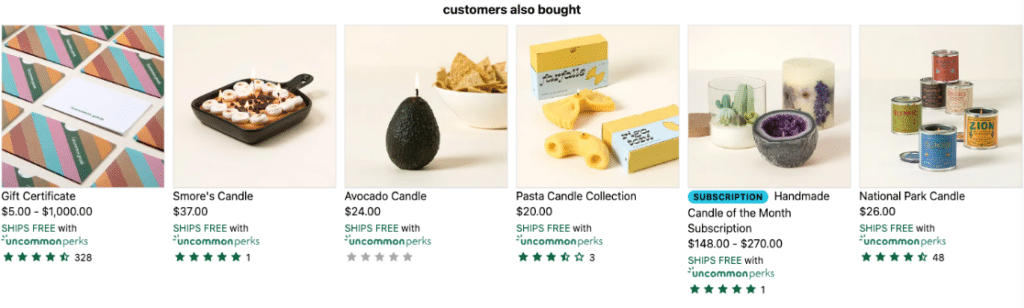
This “customers also bought” section works because it’s powered by real purchase data — not a static manual list. That’s the difference between personalization that converts and personalization that just takes up space.
How to measure this:
Use MonsterInsights’ Custom Dimensions Report (Pro) to compare logged-in vs. logged-out user behavior. Logged-in users are your returning customers — the ones your personalization is built for. If their conversion rate is meaningfully higher than logged-out users, the gap tells you personalization is working. If the gap is small, your personalized experience may not be differentiated enough to matter.
That behavioral gap between logged-in and logged-out users is one of the clearest signals you have that your personalization efforts are — or aren’t — translating into measurably different customer behavior.
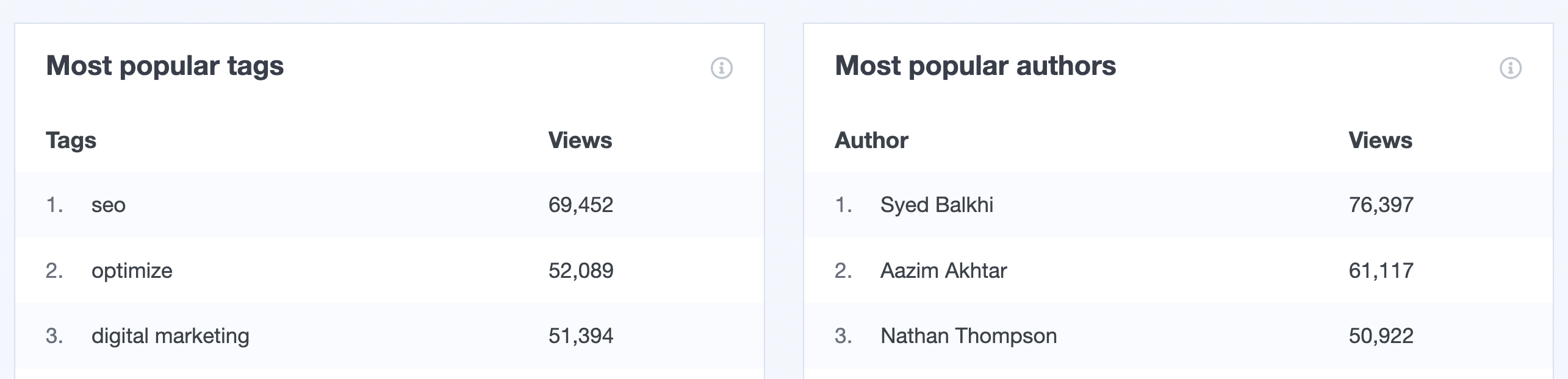
To understand what your returning customers do on-site, see the guide on user behavior analytics: tools, key metrics, and more.
6. Master Re-engagement Campaigns — and Know Which Ones Win
You have a 60–70% chance of selling to an existing customer. For a new prospect, that drops to 5–20%. That math is why re-engagement campaigns deserve real investment — not just a “we miss you” email sent once a year.
Effective re-engagement reaches customers across the channels where they actually pay attention. The tactics that tend to move the needle most:
- “We miss you” emails with a personalized offer tied to purchase history
- Triggered reminder emails for abandoned items or lapsed product categories
- Updates about new arrivals in categories they have purchased from before
- Special “win back” promotions with a clear expiry date to create urgency
- Survey emails asking inactive customers why they have not returned — the replies are invaluable
- Retargeting ads for products they have viewed but not purchased
Push notifications are one of the most underused re-engagement channels for eCommerce — and one of the most powerful. PushEngage lets you run cart abandonment recovery, browse abandonment campaigns, and automated drip sequences for WooCommerce stores — all without requiring an email address.
That’s the key differentiator: push reaches customers who never handed over their email. WooCommerce-specific features like cart abandonment, browse abandonment, and back-in-stock alerts require the Growth plan or higher.
The MI + PushEngage loop works like this: MonsterInsights shows you exactly where you’re losing customers in GA4 — which traffic sources convert once and disappear, which product categories attract one-time buyers. PushEngage then targets those same customers with push campaigns that win them back without waiting for an email opt-in.
How to measure this:
Use the MonsterInsights Source/Medium Report (Plus+) to see which re-engagement channels are actually driving sessions and revenue back to your store. For PushEngage campaigns specifically, tag each campaign link with UTMs using the Smart URL Builder — then check the Source/Medium Report to see which push campaigns drove real conversions, not just clicks.
For a complete overview of how to tag and track your campaign links, see the beginner’s guide to UTM parameters.
Use MonsterInsights User Journeys to See What Repeat Customers Actually Do
Here’s what’s interesting about looking at User Journeys for repeat customers: the pages that show up consistently in the paths of multiple-order buyers are often not what you’d expect.
MonsterInsights’ User Journeys report (Pro) shows every page a customer visited before completing a purchase — in sequence, with time spent on each page. That means you can look at the journeys of customers who have made two or more orders and start to see patterns.
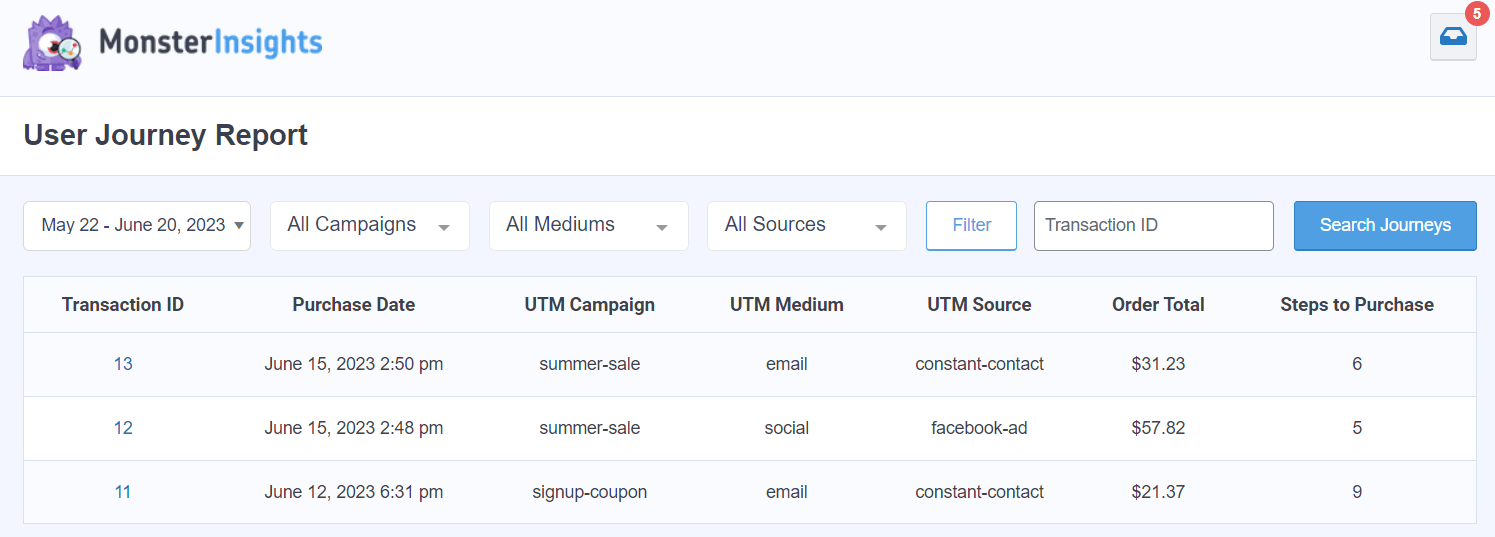
The report shows individual customer journeys — it doesn’t automatically sort by order count or build a composite repeat buyer path for you. What you’re doing manually is comparing: look at the journeys of your best customers (multiple orders, high AOV) and note which pages appear repeatedly. Then look at one-time buyers and see what’s different.
The question worth asking: do repeat customers consistently visit your blog, size guides, product care FAQs, or loyalty program page before their second purchase? If they do, that content is doing real retention work — even if it never shows up in a standard conversion report.
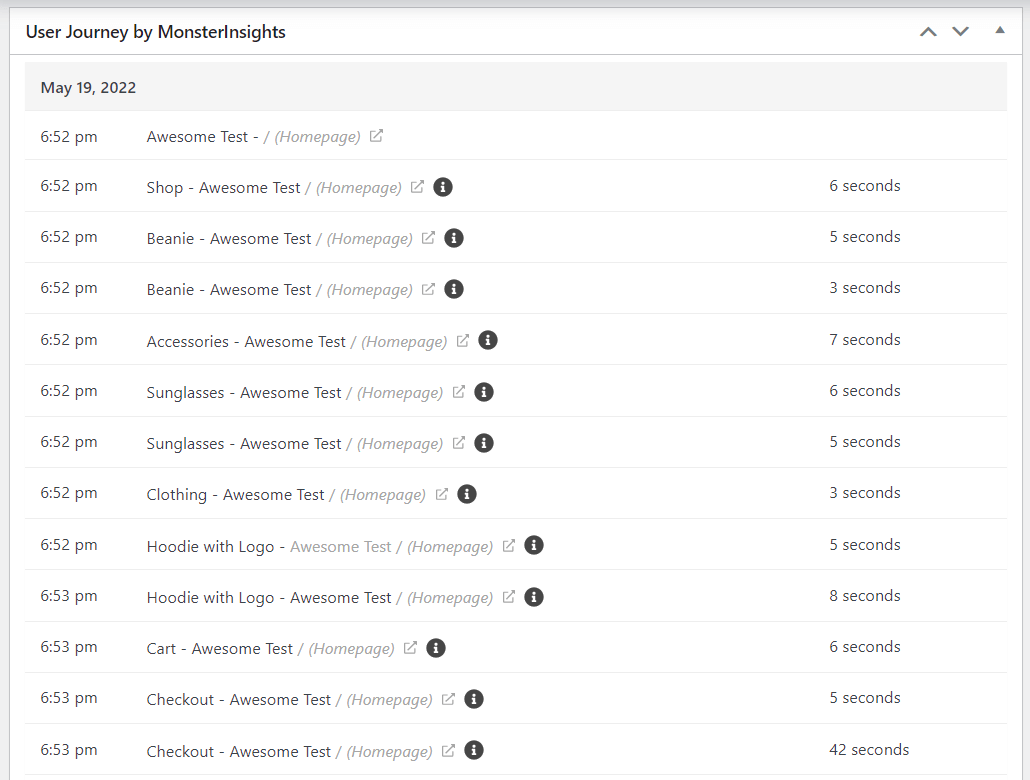
Once you’ve identified which pages repeat buyers consistently pass through, replicate those paths. Surface them more prominently — link to them from post-purchase emails, from your loyalty program dashboard, from product pages. You’re not guessing which content drives retention anymore. The data tells you.
I’d recommend starting with your top 20–30 multi-order customers and manually scanning their journeys for the 2–3 pages that appear most consistently. That sample is usually enough to spot a pattern worth acting on.
See the Exact Pages Your Best Customers Take Before Buying Again
MonsterInsights User Journeys (Pro) shows every page a customer visited before completing a purchase — in sequence, with time spent on each page. Stop guessing which content drives repeat orders. The data is already there.
See How User Journeys WorksSet Up GA4 Audiences for Repeat Buyers vs. One-Time Buyers
GA4 lets you build audiences like “customers who purchased in the last 90 days” or “customers who bought once but never returned” — but these audiences are only as reliable as the purchase data flowing into GA4. If the underlying purchase events are incomplete or misattributed, your audience definitions will be too.
MonsterInsights’ WooCommerce eCommerce tracking ensures every purchase, order value, and product detail is passed to GA4 correctly. Without it, GA4 often misses purchases or attributes them to the wrong session — which means the audiences you build on top of that data will exclude real customers or include the wrong ones.
Once MonsterInsights is set up, two audience definitions are worth creating for retention work. For repeat purchasers, build an audience where the purchase event has fired more than once — this is your highest-value segment for loyalty campaigns and early renewal offers.
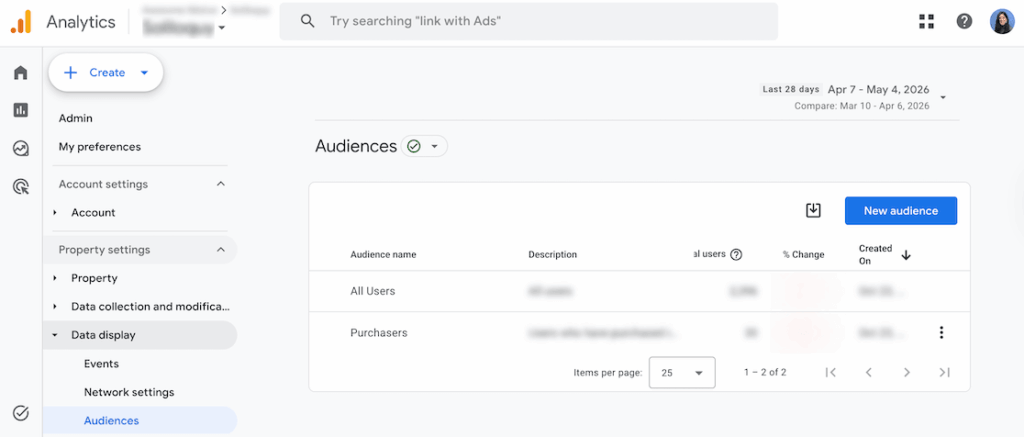
For one-time buyers, target users who triggered the purchase event exactly once and whose last purchase was more than 90 days ago. These are customers who trusted you once but haven’t come back — a targeted re-engagement campaign for this group almost always outperforms a general blast.
I develop, maintain and enhance many types of websites and build multi-channel marketing programs for my clients. MonsterInsights makes it easy to connect to a Google Analytics account and share the critical reports with my clients without training them on GA. A big win. Keep up the great work.
— Joe Kroog
FAQs About eCommerce Customer Retention Strategies
What is eCommerce customer retention?
eCommerce customer retention is the ability of an online store to keep customers coming back to make repeat purchases. It is about turning one-time buyers into loyal customers who shop with you again and again. While customer acquisition focuses on getting new customers to make their first purchase, customer retention is all about what happens after that initial sale.
What is a good customer retention rate for eCommerce?
A good customer retention rate for eCommerce typically ranges from 20–40%, depending on your industry. Luxury and high-end brands often see higher retention rates (around 50%), while lower-priced consumer goods might see rates closer to 15–25%. The key is to benchmark against your industry average and focus on steady improvement — even a 5% increase in retention can meaningfully boost profits.
How do you calculate customer retention rate?
To calculate your customer retention rate: (1) Choose a time period — month, quarter, or year. (2) Count customers at the start (A). (3) Count customers at the end (B). (4) Count new customers acquired during the period (C). (5) Apply this formula: [(B minus C) divided by A] multiplied by 100 equals your Retention Rate %. A rising retention rate over time is a reliable signal that your strategies are working.
How long should you try to retain customers?
There is no upper limit — focus on retaining customers for as long as possible. The longer a customer stays with your brand, the more valuable they become. Customers who stick around for three or more years tend to spend significantly more per order than first-year customers, and they are far more likely to refer new buyers.
What’s the difference between customer retention and customer loyalty?
Customer retention refers to keeping customers making repeat purchases, while customer loyalty is about creating an emotional connection that makes customers choose your brand over competitors — even when presented with better alternatives. Loyalty is a deeper level of retention where customers become brand advocates who actively refer others and defend your brand online.
How often should you contact customers for retention?
The right frequency depends on your industry and products. As a general guide: send a welcome email immediately after purchase, order updates as needed during fulfillment, a follow-up 3–7 days after delivery, and re-engagement outreach every 30–90 days for inactive customers. Monitor engagement rates and unsubscribes closely — they will tell you when you have crossed the line from helpful to annoying.
What metrics should I track for eCommerce customer retention?
The most important retention metrics to track are: repeat purchase rate (derived from total orders vs. unique customers over time), customer lifetime value (average order value multiplied by purchase frequency), average order value, time between purchases, churn rate, and Net Promoter Score. MonsterInsights Pro’s eCommerce Report surfaces your AOV and purchase data right inside WordPress — no GA4 login required. For a full list of eCommerce metrics to watch, see our guide to eCommerce KPIs to track in Google Analytics.
Now you have six data-backed retention strategies and the specific reports to measure each one. If you found this useful, these guides cover the next logical steps:
- eCommerce Digital Marketing Strategies, Tools, and Insights to Grow Your Store
- Crucial eCommerce Growth Strategies for 2026
- Top eCommerce Metrics and KPIs to Track in Google Analytics 4
- Essential Abandoned Cart Recovery Strategies
- eCommerce Conversion Funnel: Beginner’s Guide
- How to Set Up WooCommerce Google Analytics Tracking
Follow us on Twitter, Facebook, and YouTube for more Google Analytics tips.